Saturday, July 9, 2011

Dam Good Time


Getting into Amsterdam happened without incidence; settling in was a different story.  When trying to czech in at the hostel, they said they had somehow overbooked for the weekend and we were the odd guys out.  We were transferred over to another hostel down the street and they stuck us in a room with 2 bunk beds… but slept 5.  Moved from an overbooked hostel to an overbooked room; a bed is a bed though so it worked. 
After unloading and everything, we literally ran into Hillary, Shannon, and Colin in the new hostel’s café and found out we were staying in the same place.  We then went out to get a hot expresso before our first (of many) doner kebab dinner.  Afterwards, we popped a bottle of campaign to celebrate the 4th and paid our due homage to the red, white and blue…primarily to the red.  The Red Light Distract is pretty much exactly what I expected it to be – red lights, few clothes, red curtains and gawky tourists.  I can say I’ve done it, won’t be too torn up if I never do again.
Before I came, people said that there really wasn’t much to do in Amsterdam and it’s easy to get bored.  I want to congratulate Jorge and I for our great job of cramming 2 days of traveling into 4 days though.  We made regular trips to Dam Square and Nieuw Markt, tasted coffees from around the world, saw the van Gogh and Amsterdam History museums, toured though the Anne Frank house, and walked through Vondel Park.  The highlight though was definitely the Heineken Brewery tour.  After explaining the brewing process and detailing the Heineken history, they had a beer tasting.  Usually I’m not a Heineken fan, but a fresh beer on tap is much better than one that’s been bottled and shipped; it was good.
Overall, it was a really nice city.  The canals passing through the streets give it a really different feel from any other city I’ve been to. 

Friday, July 1, 2011

Carpe Diem pt. 2


… but this time I wasn’t taking classes to get a ticket expunged. 
Three days ago, after saying goodbye to Mom and Dad in the wee hours of the morning, I took a 6:00 am flight Madrid to Rome.  The European adventure begins.  Although I only spent two seemingly short days in Rome, I accomplished everything I had hoped to: saw the Vatican, Coliseum, Circus Maximus, Pantheon, smaller basilicas, and other Roman ruins and I also ate an authentic Italian Panini, pizza, and ravioli. 
Surprisingly, the fact that I was running on 3 hours of sleep when I touched down in Rome did not bother me at all.  I met up with Jorge at the hostel and we immediately made our way to the Vatican.  We hopped on board with a big tour group that led us through the museum and Sistine Chapel; the tour was worth it in the sense that we got to skip the loooong line to enter the Vatican City and we got at least a little bit educated on the art there; however, the tour guide seemed to be more worried about getting through the museum within some sort of time limit than he was with letting us appreciate all the sculptures, tapestries, and paintings. 
The Sistine Chapel made it worth the price of admission though.  I honestly had no idea what the Chapel looked like underneath the famous ceiling.  Michelangelo’s other fresco, the Last Judgment altarpiece, is just as awesome as the ceiling.  From the overly muscular, nude woman (because women were forbidden from being models) to the Virgin Mary’s look of desperation, the enormous, painting is absolutely spectacular.  The small room is almost too much to fully take in and appreciate because every square inch is filled with immaculate detail.
After seeing the chapel, Jorge and I split apart from the group and went into St. Peter’s Basilica.  I feel like I’m running out of adjectives that I can use to describe the Basilica that I have not already used.  All I can say is there is no more fitting of a place to have such important, special works of art than the Pope’s home city.  Pictures do not give Michelangelo’s Pieta credit.  The near life-sized, impeccably detailed statue obviously drew an enormous crowd, but it was worth the wait to get a front row view of it.  One thing I thought was really cool about the Basilica that I had not seen in any other cathedral yet, especially one that is visited as much as this one, is that they designated one capilla (the most beautiful one I think too) exclusively for prayer.  Even more surprising was that the rule was actually well enforced.
I’m not going to go into much detail about the other sites because the Vatican was far and away the favorite place I visited.  The Pantheon was the biggest surprise; I had no idea that the inside had been converted into a modern, Catholic sanctuary, so that was really cool too.  Overall, the city of Rome was unbelievable.  Its crazy seeing ancient ruins and Michelangelo sculptures everywhere you looked.  But wherever there is a yin, there has to be a yang and the yang in Rome is the people.  Sure they sound like they’re singing when they talk, but they’re harmonic speech masquerades their pillaging personality.  Twice we were horrendously ripped off by cab drivers and when we tried to catch our flight, the bus driver told us he would take us to Fiumicino Airport, but then took us to Ciampino Airport.  Also, at one pizza parlor, I ordered a 5 euro meal and Jorge got a 7 euro one; when both of us tried to pay with 10 euro bills, he said he did not have change and tried to take the full 20.
With all said and done, I’m glad I saw Rome; it was hands down one of the coolest, most historic cities I’ve ever been to.  However, I do not miss it now that I have left.  I’m in my hostel room in Prague now after spending a few hours walking the city last night.  First impression: I love this place – it’s probably going to be my favorite stop to date.  I’ll tell you about it on the 4th.

Tuesday, June 28, 2011

In Memoriam to Mr. Dalke and Bear: The Bigger Picture

Preface: this is more of a personal journal entry written in response to recent events, but I’ll try to leave it open-ended so it applies to everybody.


Some things in life are more important than ancient cities, awe inspiring cathedrals and late night discotecas. Last night I heard that my high school biology teacher and advisor, Mr. Dalke, had just passed away after a six-year fight with cancer.  With this news coming less than a month after my loyal friend and companion, Bear, was put to sleep, I really had to sit back and put things in perspective before I boarded my RyanAir flight to Rome. 
Mr. Dalke truly changed the way I looked at the world; from his lessons on sex-ed (which were cut short by his diagnosis) to the ones on the environment and from his counsel to me as an insecure freshman to our deep conversations after I graduated, he showed that he was indescribably wise for someone as young as he was.  Whereas Mr. Dalke was always a dependable mentor and friend, Bear was the most loyal companion anyone could ask for.  Despite the fact that I impatiently barked orders when I was his new owner and that I restlessly gave up throwing the ball with him after no more than 10 tosses, he always returned my apparent aloofness with love. 
As I touched down in Rome today, I began my three-week, post-Sevilla Eurotrip on a somber tone.  It is hard to complain with traveling through some of the world’s most magnificent cities; however, there is no other place that I would rather be than by Bear’s side as he took his final pants and in a church pew remembering Mr. Dalke’s shortened, albeit fulfilling life. 
If there is one thing Mr. Dalke and Bear had in common, it was their insatiable desire to explore the world around them.  Once Bear had exhausted what his small world – confined by the fence that surrounded our house – had to offer, he tirelessly dug under the fence so he could escape into the wilderness of Rivermeade; at the farm he loved nothing more than to run rampant through the foreign woods and cool off in whichever body of water presented itself.  For Mr. Dalke, his world was the water.  From the Galapagos to the Caribbean to God only knows how many reefs around the world, Mr. Dalke saw most all of the oceans wonders in his scuba expeditions.  Even as he courageously fought his cancer, he went from lake to lake just so he could escape onto the open water to go fishing. 
Today, and for the next three weeks, my world is Europe.  As much as I want to be with my two lost friends, the painful truth remains the same.  Their presence among us will truly be missed, but their spirits will remain within us forever.  While Atlanta will be filled with their memories, I will also be taking them with me to Rome, Prague, Amsterdam, Munich and wherever else I may go.  I cannot let the news of loss ruin an opportunity of a lifetime, rather I will rededicate my trip and it will take on a whole new meaning.  Like Mr. Dalke found comfort in the water and Bear found joy in the open world, I look forward to seeing what each city has to offer.  I strive to reach outside my comfort level if it means I will better experience the city and hope to leave no opportunity unexplored. 
Through it all, it is important to remember that which is most important. (Cue a soapbox for me to stand on for a paragraph).  Life is a fragile, miraculous gift we are given, and the relationships that we build throughout its course are the most precious treasures in the world.  To those that you love, let them never forget it; to your friends, never take them for granted; to your enemies, try to offer forgiveness because life is far too short to hold senseless grudges.  I have been blessed with the greatest parents, friends, peers and mentors in the world.  It’s a shame that it takes a tragedy for me to remember this, but without you, life would be meaningless.  Thank you to everybody who has helped make me the person I am today – especially Bear and Mr. Dalke; I am forever indebted to you all. 
And with that, I am off to see the world.  I will tell you all about Rome when I write my summary sometime in the next few days.  I am excited for what is to come and will be sure to keep everyone posted throughout my journey.  As I sign off, I ask that you please keep Mr. Dalke and his family in your thoughts and prayers.
Cheers,
Harrison

Thursday, June 23, 2011

Study Abroad in Review


As I sit for my final siesta in the stuffy room that I have grown to call home, I figured it is as good a time as any to reflect on the past 6 weeks.  Its hard believe that my stay in Sevilla is actually coming to a close.  It feels like just yesterday that I first introduced myself to Carmen and Patricia dubbed me "Pepe;" at the same time though, I feel like I have been in Sevilla for several months.  Although I am sad that the program has come to an end, that I have had to say my goodbyes and that Sevilla will soon become a memory rather than a reality, I am excited for the rest of my Euro-travels.
Without question, the most rewarding part of the trip was the relationships made.  I already knew a handful of people going into the trip, but we were only a small part of the 60+ people in the program.  It was a very congenial group that did just about everything together en masse, from botellon to bull fights to weekend trips.  I'm excited to get back to school to see everyone again - bring Calle Betis to Franklin St.
Of course the reason you study abroad is to study abroad.  I can honestly say that I did learn a lot of grammatical structures that make speaking and writing sound a lot more natural, and I do look at the city with a new eye, noticing baroque and islamic architecture in the buildings around me.  My teachers Angeles and Fernando were great; they were good at communicating with people who speak Spanish as a second language and were very probably the best Spanish teachers I've had.  They did not assign too much work either, so I never felt bogged down with school.  
With little stress coming from school, we had plenty of time to explore the city and its nightlife.  In a city that boasts the most bars per capita in Europe, it was not hard to something to do at night.  Weather we met up with friends at a local joint or went to Fundicion/Buddha/Bilindo under the local promoter Toba Turbo's direction, there was never a dull night.
When the city dies in the middle of the day for siesta, it can be hard to wake back up and build momentum to do something during the day.  I admit that I fell victim to a few siestas that lasted from lunch to dinner.  However, I was able to stay active most of the time by playing basketball 3 or 4 times a week.  It was cool to actually know some locals and learn a few colloquialisms from talking to them.
Being on the Iberian Peninsula, we were lucky to have the chance to go to so many different places on the weekends.  Every city in Spain has its unique character and it was amazing to such famous places as the Alhambra and the Rock of Gibraltar.
Being in Europe, I have the even luckier opportunity to travel throughout the continent for the next three weeks.  All that is planned for now is Rome, Prague and Amsterdam with Jorge for the first two weeks.  After that my final week is flexible; possible destinations include Munich, Switzerland or maybe Brussels.  I will be sure to keep updating as often as possible and report how it is.
People always say that study abroad is a once in a lifetime experience.  However tomorrow, I will say goodbye to Spain for the second time in four years.  Both of those summers have been the most rewarding and fun summers I can remember.  Its really interesting to live within a different culture and adapt to their norms; also my ability to speak and understand Spanish has improved significantly.  I would encourage anybody who has the opportunity to study abroad to do so; its been the best parts of my college experience thus far.
Hasta luego Sevilla.  To everybody in the program, I look forward to seeing you at the Hill in August (and to those that don't go to UNC, I hope yall come visit at some point).  Leaving Sevilla though, I know that the fun has only just begun.  I don't come back home until July 15 and I got a lot ahead of me until then; I'll keep you posted.

Tuesday, June 21, 2011

Destinations: Gibraltar and ...Cadiz?


With the program quickly approaching its final days, the opportunity to travel around Spain is slowly vanishing.  Especially after staying in Sevilla last weekend, I really wanted to take advantage of my last weekend here despite the paper I had due Monday and final exams on Tuesday and Wednesday.  What better place to go than to revisit the site of my first summer abroad experience - Cadiz?  That was the original idea at least.  We were going to drive down to Gibraltar and spend an evening / night there, then head over to my old stompin' grounds in the morning to relax at the beach and visit the historic city.  It was entirely too well planned to be properly executed.
When googling "hostel in Cadiz," I stumbled upon a 4-star hotel that cost only 5 euro/night more than any hostel did - obvious choice.  Only after booking it did I think to see where it was in the city; it wasn't in the city.  It was in Algeciras, a city an hour and a half away from Cadiz but 30 min away from Gibraltar.  A simple folly that actually worked in our favor.  Who really needs an overcrowded beach and cathedral when you have a private pool, putt-putt course and resort?
(Un)fortunately, no busses go from Sevilla to Gibraltar, so we actually went for the cheaper, faster option and rented a car.  Nothing like a long road trip.  (On that note, props to Danielle for navigating Spanish traffic, roundabouts and incomprehensible road signs - all the while driving stick-shift.)
As a city, Algeciras is not that impressive; it is a grimy port city that serves more as a checkpoint for people visiting Gibraltar.  For a hotel, Hotel Reina Cristina was exactly as it appeared online: a pristine, clean little castle.
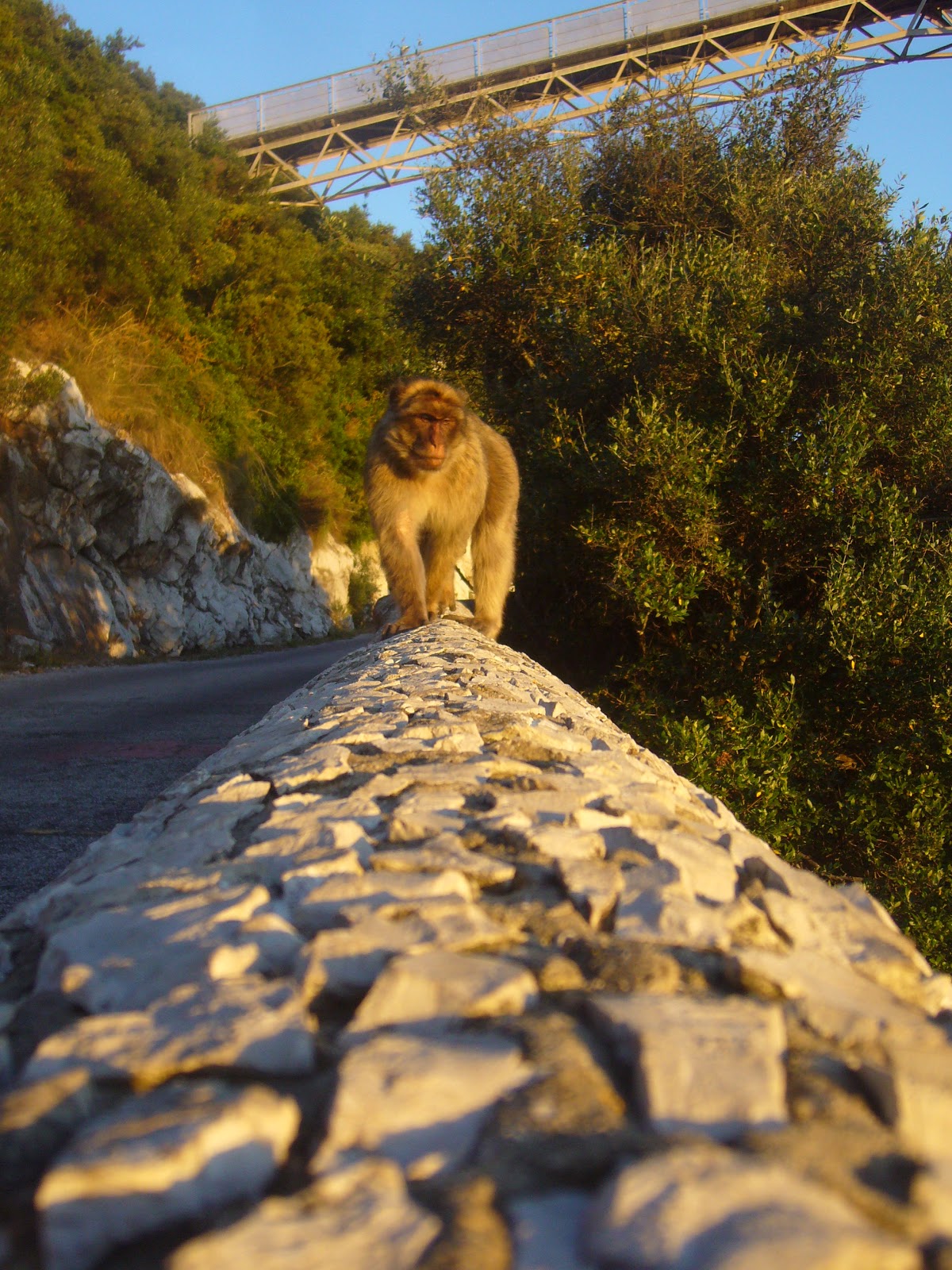
After we settled in, we reloaded into the car and made our way toward Gibraltar.  Crossing the boarder into the British territory might have been one of the most casual traveling experiences I've had; however, we were so taken aback to see an adult out of our program speaking English that we almost completely lost our communication skills.  We were an hour or so away from sunset, so we didn't waste anytime getting to the Rock of Gibraltar and begin our "monkey business"... if you will.  The first miracle of the trip that the tiny VW got up the mountain; the second one was that it survived its stay there.  The initial encounter with the monkeys was a peaceful one.  We saw him casually sitting on the wall next to the road and walked alongside us as we drove by.  When we parked the car, the frighteningly human-like creature perched himself on the fence and almost posed for us.  Its amazing how his facial expressions, hands and feet resembled our own.  He was a very peaceful, contemplative monkey.  If only the next ones were as amiable.  On our return down the mountain, we stumbled upon what could have been the most adorable monkey family I have ever seen.  Of course, anything that is cute has to be scheming something, and we fell right into their trap.  As we stopped the car to take pictures of the playful baby monkeys, we failed to notice mama and papa monkey walking toward the car.  By the time we noticed, it was too late; the monkeys had already climbed on board and were jumping up and down on the roof Jumanji-style.  Then, one climbed down the roof and tried to latch on and pull on the back windshield wiper.  Conscious of the security deposit on the rental car, we sped away before he had the chance to destroy the car.  By that time, it was already sundown so we returned to the hotel and retired for the night.  The hotel rooms were air conditioned, so we were able to sleep in and did not drown in our own sweat.  The next day, we lived the dream.  We spent the entire day out by the pool laying out and monkeying around, played a little putt-putt and explored a little bit around the city (we soon realized there was not much there and returned back to our oasis).
Overall, I was excited to see Cadiz, but I do not regret missing it too much.  It was a successful road trip and everybody involved had a good time.

Tuesday, June 14, 2011

Tourist Weekends in Spain


So I may be a perfectionist about writing, but keeping up with it is a whole 'nother story.  Sorry I haven't posted in a while, I've tried to make up for it as best as I could - the result is a looong post.  I'll try to keep up with it better in the future.  Pictures to go along with this post will be up in the next few days, I can't find my camera's connection cord.
I have not written in the past week in part out of laziness, but also because nothing especially newsworthy had really happened.  After living here for a few weeks I have grown comfortable with my surroundings and have developed a sort of routine to my day: wake up early for class, go to school from 9:30 – 13:30, return home for lunch then siesta until 17:00, meet up with people and grab a beer or play basketball, return for dinner, then head out for the night.  Our first few weekends we spent as vacationers relaxing on white beaches; these past two weekends though, we opted for the role of tourists as we explored Cordoba, Grenada and our home city Sevilla. 
Two weekends ago, we went to Cordoba and Grenada with our program.  Both cities are filled with history and are particularly influenced by their Arabic past.  This is no better exemplified than by the cathedral in Cordoba.  If I didn’t know any better when walking in, I would have thought it was a mosque.  Evidently enough, the main entrance is indeed the original entrance to the ancient Arabic mosque.  Filled with red and white arches and beautiful mosaics, there is hardly any Christian influence when you first enter (for a more in depth description, look at Shannon’s blog.  She took an “introduction to Islamic art class at UNC and can tell you anything and everything about it).  However, just around the corner, I found one of the most impressive altars I have seen yet.  Come to think about it, all the altars I have seen are equally impressive; I just think the one I have seen most recently is freshest in my memory and stands out.  The most spectacular part about this particular cathedral was the juxtaposition of the red/white Islamic arches and the pristine white marble statues.
The next day, our group took an overnight trip to Grenada.  For all that the city has to offer, it was necessary for us to spend two days there.  Our first stop, of course, was la Alhambra.  I mentioned in one of my previous posts that the Real Alcazar was very similar to la Alhambra, and that I liked the Real Alcazar better.  I stand by both of those comments.  That is not at all to discredit the Alhambra; it is regarded as one of the top wonders of the modern world and is very deserving of that recognition.  Fernando also led this tour and described in detail the symbolism and architecture of everything inside.  Unfortunately one of the most famous sites of the Alhambra, the “Patio de los Leones” – a fountain held up by lions, symbolic of life and power – was under reconstruction, so we missed out on that.  Also, because we were pressed for time, we did not get to walk around all of the expansive gardens that I had gone through 4 years earlier.  I know I am writing this as a snobby, second-time visitor so I am not accurately portraying how breathtakingly beautiful it is.
The site in Granada that did grab my attention was the Cathedral, el Catedral de la Encarnación.  While most of the cathedrals we had visited had the same base grey stone color, were predominantly rectangular, and usually built in the Baroque era, this Cathedral was a bright white, had a semi-circular alter, and was of the Renaissance style.  The stone was originally painted white so that it could later be embellished with ugly gold leaf patterns, but luckily financial restrictions prevented them from doing so.  Instead the white columns and walls inspire a sense of awe absent in all the other cathedrals.
Like Sevilla, Grenada is a college town so the nightlife is usually on par with that in Sevilla.  Unfortunately, we were there for a Sunday night.  Unlike Sevilla (more like Cadiz), the Arabic influence in Grenada is much more obvious.  With the discos all closed, our group stopped into a hookah bar for some Middle Eastern tea and strawberry flavored hookah.  The ambience was rather relaxing, which is saying a lot considering my normal day includes siesta and grabbing a beer at a bar.
Continuing on to this past weekend; while most in the group went to Lagos, Barcelona or Cadiz, Jorge and I gave ourselves the time to be a tourist in our home-base in Sevilla.  Just like it has been years since I’ve seen most of Atlanta’s landmarks like the High Museum, Stone Mountain, and Botanical Gardens, Jorge and I noticed that we have overlooked many of Sevilla’s tourist destinations despite them being right around the corner.  The two main attractions we went to were the Plaza de España and el Museo de Bellas Artes. While I don’t think Museo de Bellas Artes is anywhere near as cool as the Prado in Madrid, it still had a wealth of important paintings and sculptures.  The most expansive galleries were those of Murillo, Velázquez, Bilbao, El Greco (not nearly as many by El Greco as the Prado), Juan de Valdéz Leal, and a few others I had never heard of before.  It was really cool to walk through because a lot of the sculptures and paintings that we had talked about in class were held in el Museo.
From the outside, the C-shaped Plaza de España is very unassuming except for the visible towers that mark the endpoints of the ‘C;’ the 10(ish)-foot outer wall is more or less bare and you have to walk around it until you reach one of the 2 entrances.  After walking through the door, the real view is still more-or-less hidden.  You have to walk up a flight of stairs and make a turn before you react with the inevitable “wow!”  I cannot really explain what makes it so spectacular without showing a picture; but between the mosaics, grand fountain, and endless arches, it really is a sight to behold. 

Tuesday, May 31, 2011

Justifying Study Abroad

As if the experience alone is not reason enough to justify my study to Spain, I site an article from The New York Times' website:
http://www.nytimes.com/2011/05/31/science/31conversation.html?_r=1&smid=tw-nytimes
Copied and pasted for your convenience:

A cognitive neuroscientist, Ellen Bialystok has spent almost 40 years learning about how bilingualism sharpens the mind. Her good news: Among other benefits, the regular use of two languages appears to delay the onset of Alzheimer’s disease symptoms. Dr. Bialystok, 62, a distinguished research professor of psychology at York University in Toronto, was awarded a $100,000 Killam Prize last year for her contributions to social science. We spoke for two hours in a Washington hotel room in February and again, more recently, by telephone. An edited version of the two conversations follows.
Chris Young for The New York Times
MENTAL WORKOUT Ellen Bialystok with a neuroimaging electrode cap.
Q. How did you begin studying bilingualism?
A. You know, I didn’t start trying to find out whether bilingualism was bad or good. I did my doctorate in psychology: on how children acquire language. When I finished graduate school, in 1976, there was a job shortage in Canada for Ph.D.’s. The only position I found was with a research project studying second language acquisition in school children. It wasn’t my area. But it was close enough.
As a psychologist, I brought neuroscience questions to the study, like “How does the acquisition of a second language change thought?” It was these types of questions that naturally led to the bilingualism research. The way research works is, it takes you down a road. You then follow that road.
Q. So what exactly did you find on this unexpected road?
A. As we did our research, you could see there was a big difference in the way monolingual and bilingual children processed language. We found that if you gave 5- and 6-year-olds language problems to solve, monolingual and bilingual children knew, pretty much, the same amount of language.
But on one question, there was a difference. We asked all the children if a certain illogical sentence was grammatically correct: “Apples grow on noses.” The monolingual children couldn’t answer. They’d say, “That’s silly” and they’d stall. But the bilingual children would say, in their own words, “It’s silly, but it’s grammatically correct.” The bilinguals, we found, manifested a cognitive system with the ability to attend to important information and ignore the less important.
Q. How does this work — do you understand it?
A. Yes. There’s a system in your brain, the executive control system. It’s a general manager. Its job is to keep you focused on what is relevant, while ignoring distractions. It’s what makes it possible for you to hold two different things in your mind at one time and switch between them.
If you have two languages and you use them regularly, the way the brain’s networks work is that every time you speak, both languages pop up and the executive control system has to sort through everything and attend to what’s relevant in the moment. Therefore the bilinguals use that system more, and it’s that regular use that makes that system more efficient.
Q. One of your most startling recent findings is that bilingualism helps forestall the symptoms of Alzheimer’s disease. How did you come to learn this?
A. We did two kinds of studies. In the first, published in 2004, we found that normally aging bilinguals had better cognitive functioning than normally aging monolinguals.Bilingual older adults performed better than monolingual older adults on executive control tasks. That was very impressive because it didn’t have to be that way. It could have turned out that everybody just lost function equally as they got older.
That evidence made us look at people who didn’t have normal cognitive function. In our next studies , we looked at the medical records of 400 Alzheimer’s patients. On average,the bilinguals showed Alzheimer’s symptoms five or six years later than those who spoke only one language. This didn’t mean that the bilinguals didn’t have Alzheimer’s. It meant that as the disease took root in their brains, they were able to continue functioning at a higher level. They could cope with the disease for longer.
Q. So high school French is useful for something other than ordering a special meal in a restaurant?
A. Sorry, no. You have to use both languages all the time. You won’t get the bilingual benefit from occasional use.
Q. One would think bilingualism might help with multitasking — does it?
A. Yes, multitasking is one of the things the executive control system handles. We wondered, “Are bilinguals better at multitasking?” So we put monolinguals and bilinguals into a driving simulator. Through headphones, we gave them extra tasks to do — as if they were driving and talking on cellphones. We then measured how much worse their driving got. Now, everybody’s driving got worse. But the bilinguals, their driving didn’t drop as much. Because adding on another task while trying to concentrate on a driving problem, that’s what bilingualism gives you — though I wouldn’t advise doing this.
Q. Has the development of new neuroimaging technologies changed your work?
A. Tremendously. It used to be that we could only see what parts of the brain lit up when our subjects performed different tasks. Now, with the new technologies, we can see how all the brain structures work in accord with each other.
In terms of monolinguals and bilinguals, the big thing that we have found is that the connections are different. So we have monolinguals solving a problem, and they use X systems, but when bilinguals solve the same problem, they use others. One of the things we’ve seen is that on certain kinds of even nonverbal tests, bilingual people are faster. Why? Well, when we look in their brains through neuroimaging, it appears like they’re using a different kind of a network that might include language centers to solve a completely nonverbal problem. Their whole brain appears to rewire because of bilingualism.
Q. Bilingualism used to be considered a negative thing — at least in the United States. Is it still?
A. Until about the 1960s, the conventional wisdom was that bilingualism was a disadvantage. Some of this was xenophobia. Thanks to science, we now know that the opposite is true.
Q. Many immigrants choose not to teach their children their native language. Is this a good thing?
A. I’m asked about this all the time. People e-mail me and say, “I’m getting married to someone from another culture, what should we do with the children?” I always say, “You’re sitting on a potential gift.”
There are two major reasons people should pass their heritage language onto children. First, it connects children to their ancestors. The second is my research: Bilingualism is good for you. It makes brains stronger. It is brain exercise.
Q. Are you bilingual?
A. Well, I have fully bilingual grandchildren because my daughter married a Frenchman. When my daughter announced her engagement to her French boyfriend, we were a little surprised. It’s always astonishing when your child announces she’s getting married. She said, “But Mom, it’ll be fine, our children will be bilingual!”


Tuition dollars hard at work - for now, and for the future.  The next trick is keeping it up in the States